
Unlock the Editor’s Digest for free
Roula Khalaf, Editor of the FT, selects her favourite stories in this weekly newsletter.
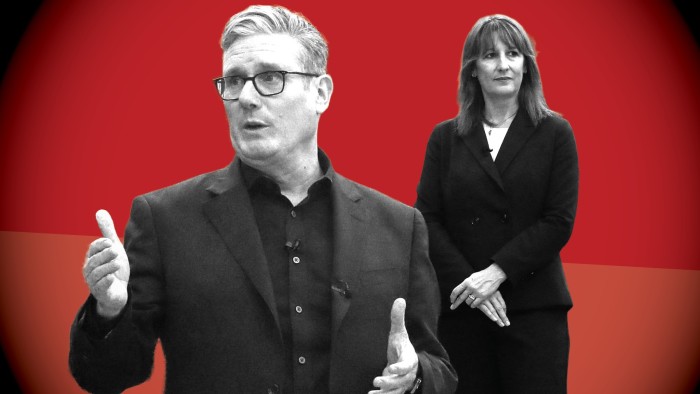
When Prime Minister Sir Keir Starmer and chancellor Rachel Reeves took office, cabinet colleagues praised them as the adults in the room, contrasting their promises of stability with the tumult of the post-Brexit Conservative governments.
Fast forward 16 months and Starmer’s allies this week managed to inadvertently stoke talk of a coup against their own leader, while Reeves’ Budget preparations have been derided as “chaotic” after sparking a sell-off in government bonds following a U-turn on raising income tax.
For Labour MPs, already despairing as their party languishes on less than 20 per cent in the polls, the past week has crystallised their unhappiness and poses an existential threat to the ill-defined Starmer and Reeves project.
“It’s now a question of when, not if, for Starmer and Reeves — they are going to go,” one backbench Labour MP said. “Their credibility has been shot to pieces, so a challenge will come.”
The sense that something has to give permeates all levels of the party, with one minister acknowledging the chances of Starmer being replaced are much “higher at the end of the week than they were at the start of the week”.
The late U-turn on raising income tax cemented the feeling in Westminster that the government was losing its grip. Reeves had heavily trailed her plan ahead of the November 26 Budget as necessary to fix the public finances — even if it meant breaking a core Labour election manifesto pledge.
Asked on Friday if Reeves and Starmer had made the right decision, one minister said “Fuck no”, arguing the chancellor’s claim, made just 10 days ago, that she would put “national interest” ahead of “political expediency” now rang hollow.
“The point of this Budget was to give us the best possible chance of winning the next election,” the minister added. “This Budget is now short-term survival over winning in 2029.”

People close to the Budget preparations argued Reeves was able to ditch the planned increase in income tax because the latest figures from the Office for Budget Responsibility suggested the fiscal hole she needed to plug was smaller than first feared.
Once believed to be as large as £30bn, the fiscal gap has been revised down to about £20bn by the end of this parliament thanks to stronger wage growth and tax receipts.
But coming so soon after Starmer’s weakness and the paranoia gripping Number 10 had been exposed by a bungled briefing that he would fight any challengers to his leadership — before any rivals had really emerged — led many to conclude Reeves had made a political choice.
Government officials did not deny the U-turn was a political as well as a fiscal decision. “Of course politics played a role,” said one. Another admitted it was “better to backtrack on the plan before the Budget than after it”, a hint that anxious Labour MPs may not have supported it.
Starmer and Reeves concluded the new OBR forecasts created just enough wriggle room for them to put together a Budget without raising income tax rates — a toxic plan euphemistically described in Treasury papers as “engaging the manifesto”.
One person briefed on the decision said Starmer and Reeves discussed ditching the income tax increase last weekend, before the OBR’s revised forecasts arrived on Monday.
This raises questions about why Reeves again strongly indicated she was about to ditch the manifesto promise in a BBC interview on that Monday, when plans to scrap the proposed income tax rise were already afoot.
Government ministers and Starmer’s allies insist that breaking the manifesto was always a genuine plan but it appears Reeves decided to keep stoking expectations even when it was receding as an option.
The fact the media and MPs believed an income tax rise was coming presented Reeves with a tempting possibility: capping her Budget speech on November 26 with the surprise announcement that she could balance the books without touching income tax rates after all.
The decision leaked, however — the Financial Times broke the news on Thursday night — creating a sense of political chaos, market panic and a feeling that the Budget was unravelling. Treasury officials insisted there had never had been a plan to treat the policy as a “rabbit out of the hat” on Budget day.
On Friday the prime minister’s official spokesperson said Reeves planned to deliver a “fair” Budget that would help deliver “stability” to the public finances, and indicated that Starmer was happy with how the chancellor had carried out her preparations for November 26.
But one backbench Labour MP said: “No one is inspired, no one is confident, as it doesn’t feel like she has a plan.
“She wanted to be the City’s chancellor, the grown-up in the room. What a laugh that’s turned out to be.”
With UK interest payments on its debt running in excess of £100bn a year, far more than the country spends on defence or education, Starmer and Reeves’ allies have argued Labour cannot afford to replace them as borrowing costs might soar further.
The gilt sell-off on Friday — the worst since July — might undermine that argument.
The events of the past week may also have underlined the view that Starmer and Reeves have failed to communicate their vision both to voters and the Labour party.
“There is no animating spirit at the heart of this government,” one Labour adviser said.
It has long been conventional wisdom in Westminster that the moment of maximum political peril for Starmer and Reeves will be after elections to the Scottish parliament and Welsh senedd in May, when there will also be polls for councils in England.
But asked whether they thought Starmer might have to be replaced before the May elections, the Labour adviser said: “How useful is six months of stasis?”
Additional reporting by Ian Smith in London